How SMBs Are Scaling With AI Agents in 2026
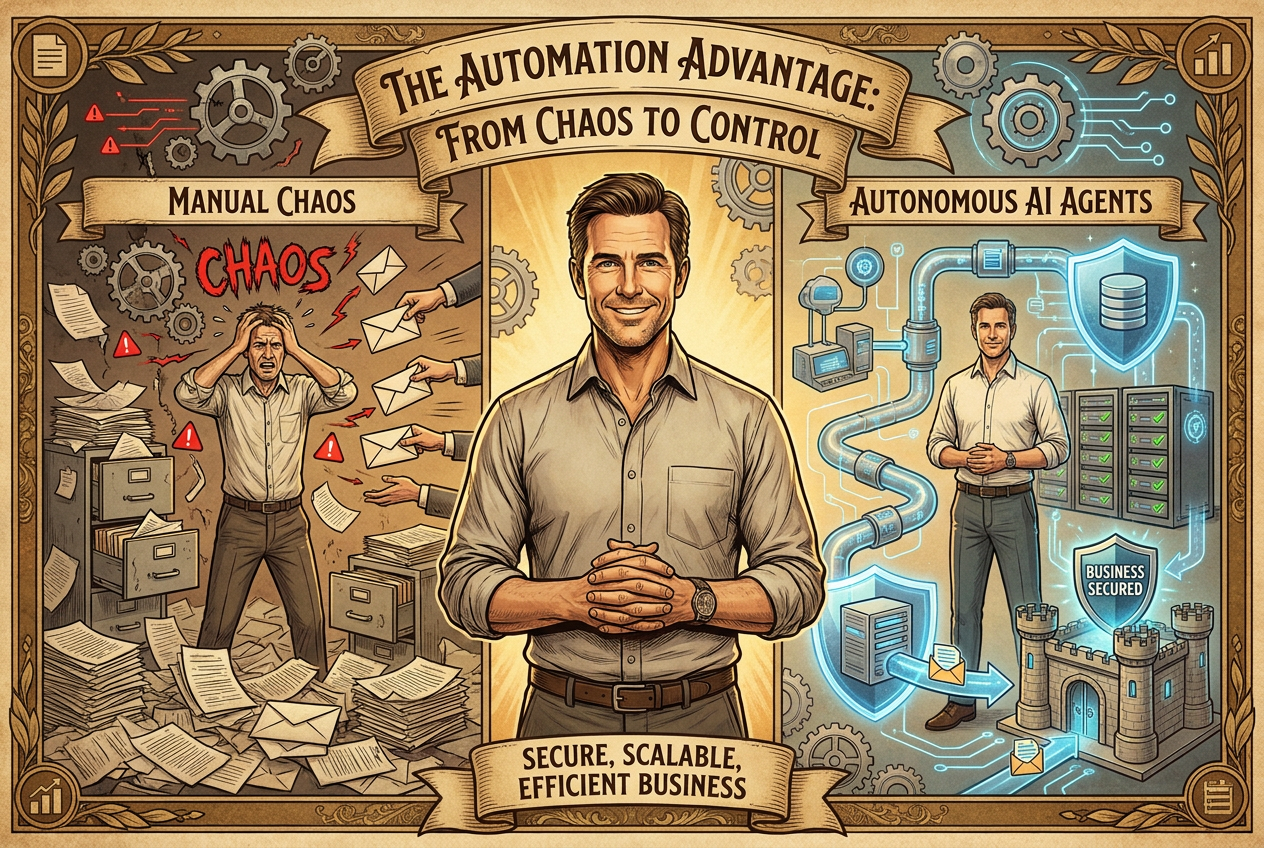
AI moved from experiment to core engine for SMBs this year. The ones installing agentic systems are seeing faster payback and real operational freedom while the rest keep grinding old workflows.
By Jeffery Boyle, Bemodo, CEO · Published · 5 min read · 1,186 words · Operations
Fifty-seven percent of U.S. small businesses are investing in AI technology this year. AI agents are no longer experimental; they are operational infrastructure replacing manual workflows with autonomous systems. The conversation shifted from "should we try it" to "how fast can we wire it in." The companies treating AI agents as business infrastructure rather than productivity tools are pulling ahead while their competitors remain founder-dependent on manual processes.
The winners stopped treating AI like a fancy spreadsheet add-on. They turned it into autonomous agents that run whole workflows while the team focuses on the work that actually needs a human brain. We are talking about AI agents that handle customer intake; route support tickets; generate proposals; and manage follow-up sequences without a single manual handoff.
The difference between companies deploying AI agents versus companies buying AI tools is the difference between owning a business and owning an expensive hobby.
Check out how I am using agents to know me, and my style, better.
<iframe src="https://player.vimeo.com/video/1199573681" width="100%" height="400" frameborder="0" allowfullscreen></iframe>
The Adoption Reality Check
Most SMBs are past the pilot phase. Thirty percent of employees now use AI every single day. The gap that still trips people up is execution speed versus strategy speed.
Many teams buy tools faster than they redesign the process those tools are supposed to fix. That is the classic VHS-era mistake: great machine, terrible tape.
The smart operators are mapping their existing workflows first; then building agents around those workflows. The backwards approach is buying an AI tool and hoping it magically fixes a broken process. One creates scalable systems; the other creates expensive digital clutter.
Think about customer onboarding. Most companies have seventeen different touchpoints spread across email; CRM notes; phone calls; and manual follow-ups. An AI agent can handle intake forms; qualification questions; calendar scheduling; document collection; and initial proposal generation in one connected sequence. No human handoffs until the prospect is qualified and ready for a real conversation.
ROI That Actually Shows Up
The payback numbers are hard to ignore once the agents are live. Businesses that moved to multi-step agent systems report average returns of 5.8 times within fourteen months and break even in three to six months.
Revenue and cost lines both move. The ones who measure against concrete metrics instead of vague efficiency slogans see the difference fastest.
The revenue side shows up in faster response times and higher conversion rates. When your AI agent responds to leads in sixty seconds instead of six hours; more prospects stay engaged. When proposal generation drops from three days to thirty minutes; you close deals while competitors are still drafting their first email.
The cost side is even more dramatic. One mid-market consulting firm replaced two full-time administrative roles with an AI agent system that handles client communications; project updates; and invoice processing. The annual savings hit six figures while service quality improved because the agents never forget follow-ups or miss deadlines.
The hidden benefit is founder freedom. When your business runs core processes without your direct involvement; you can focus on strategy instead of putting out daily fires.
The Operator Shift
The new model is small human teams plus a tight stack of agents. Companies are redesigning around that reality instead of bolting AI onto the old org chart.
The ones still demanding more meetings and more manual oversight are watching the gap widen. Clinical sarcasm time: hustle culture meets agent culture and hustle loses.
Traditional org charts assume every task needs human supervision. Agent-first companies flip that assumption. Humans handle strategy; relationship building; and complex problem-solving. Agents handle data processing; routine communications; and workflow orchestration.
This shift requires different hiring priorities. Instead of adding more coordinators and assistants; smart companies hire systems thinkers who can design agent workflows. Instead of micromanaging every task; they focus on output quality and process optimization.
The psychological adjustment is harder than the technical one. Founders who built their identity around being indispensable struggle to trust automated systems. The ones who embrace the transition discover they can scale revenue without scaling stress.
The Blueprint
Start with workflows that have clear inputs and predictable outputs. Customer support ticket routing is perfect because the decision tree is logical. Sales follow-up sequences work because the timing and messaging patterns are repeatable.
Avoid starting with workflows that require heavy creative judgment or complex relationship management. Let humans handle the nuanced conversations while agents manage the data flow and routine communications.
The key is connecting your agents to existing business systems instead of creating parallel processes. If your CRM tracks lead sources; make sure your intake agent updates those fields automatically. If your accounting system needs specific invoice formats; build that structure into your billing agent.
The Verdict
AI agents reward the teams willing to redesign the job instead of just speeding up the old one. The rest keep paying for tools they never fully deploy.
The companies winning with AI agents share one trait: they stopped asking "how can AI help with this task" and started asking "how should this process work if we designed it from scratch today." That mindset shift separates infrastructure builders from tool collectors.
Want the clearest picture of where your current setup leaks time and margin? Run the Revenue MRI diagnostic and see the exact freedom score.
2026 Deep Insight
The research shows measurable adoption gains paired with a persistent readiness gap. The operators closing that gap fastest are the ones treating AI as infrastructure rather than another shiny app.
By 2026; the valuation gap between agent-powered companies and manual-process companies will be impossible to ignore. Buyers will pay premium multiples for businesses that run without founder dependency. The manual grind becomes a liability when sophisticated buyers can see the operational risk in your P&L.
The companies building agent infrastructure today are creating competitive moats that will be expensive to replicate later. First-mover advantage in AI deployment is not about the technology; it is about the organizational learning curve and process optimization that takes months to develop properly.
The Evidence Locker
Tags: ai-agents, automation, operations, productivity, leadership